

PTFE Tube and Rod Factory: The Art of Crafting High-Performance Fluoropolymer Parts
2026-11-16
Think you know PTFE? Wait until you see how TAIFNO turns raw fluoropolymer resin into tubes and rods that shrug off aggressive chemicals, extreme heat, and relentless friction. This isn't mass production—it's a craft, where every millimeter of extruded stock is checked for the kind of consistency that high-stakes industries demand. Let's step inside the factory and see what separates premium PTFE parts from the ordinary.
PTFE Without Compromise: How Our Tubes and Rods Take Shape
Most PTFE processing shortcuts show up later as warped tubes, uneven rod stock, or surface porosity that nobody notices until a seal fails. We run a slower, paste-extrusion cycle for our tubes, keeping ram pressure low enough that the resin fibrillates evenly instead of shearing into weak planes. The result is a wall that measures consistent within a few thousandths along the full length, without the brittle spots that plague high-speed ram extrusion.
For solid rod, we skip the common trick of repressing sintered scrap. Virgin PTFE powder is isostatically compacted in flexible molds, then sintered in a digitally profiled oven where the temperature ramps up and down in stages matched to the rod diameter. That prevents the core from lagging behind the skin during cooling, so you don't get the internal stress cracks that turn into split rods when someone machines a deep groove.
Every batch gets a quick turn on a laser micrometer and a density check before it ships. We also keep a small cut-off from each lot in the lab for a week, re-measuring to catch any delayed dimensional drift. It's not the cheapest way to make PTFE stock, but it's the only way we've found to make it behave the same on the tenth order as it did on the first.
The Unseen Workhorse: Why Fluoropolymers Excel in Tough Conditions
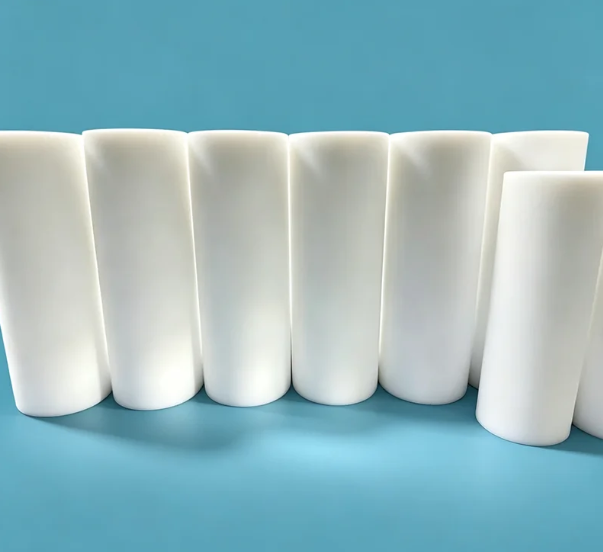
Most engineers rarely give fluoropolymers a second thought until a conventional material fails in a way that halts production or compromises safety. Yet these plastics—built around carbon-fluorine bonds, one of the strongest in organic chemistry—quietly handle the jobs that metals, elastomers, and standard thermoplastics simply cannot. A PTFE seal inside a chemical pump, for instance, shrugs off concentrated sulfuric acid at 200°C while maintaining dimensional stability. A PFA lining in a semiconductor fab resists the corrosive etch gases that would eat through stainless steel in weeks. The reason is simple: fluorine atoms form a dense, inert shield around the polymer backbone, leaving almost no reactive sites for solvents, oxidizers, or even UV radiation to attack.
This molecular armor also delivers a remarkably low coefficient of friction and a wide service temperature window, often from -200°C to over 260°C, depending on the specific grade. In dynamic applications—think rotary shaft seals in oilfield equipment or sliding bearings in food processing lines—fluoropolymers reduce wear without external lubrication, which is a huge advantage where lubricants would contaminate the product or degrade under aggressive chemicals. Unlike many plastics that become brittle in cryogenic conditions or soften near boiling water, materials like PVDF and FEP retain toughness and flexibility across the extremes. That performance consistency is why designers specify them not as a premium upgrade, but as the only viable choice for valve seats in chlorine gas service, gaskets in fuel cells, and wire insulation inside jet engines.
Even beyond chemical and thermal resistance, fluoropolymers prevent a subtle but costly problem: fouling and adhesion. In adhesive manufacturing, nothing sticks to a PTFE-coated mixer blade, so product doesn't build up into a charred mess that requires downtime for chiseling. In pharmaceutical freeze-drying, a PFA tray releases the dried cake cleanly, minimizing cross-batch contamination. These materials rarely grab headlines, yet they sit at the heart of processes that make clean water, semiconductors, life-saving drugs, and reliable aerospace components possible. The next time a system runs without incident under conditions that would destroy lesser materials, chances are a fluoropolymer is doing the heavy lifting out of sight.
Molding, Extruding, Perfecting: The Life of a PTFE Rod
The journey of a PTFE rod starts not with melting, but with cold compression. Fine polytetrafluoroethylene powder, often blended with a small amount of lubricant, is packed into a cylindrical mold. Under high pressure at room temperature, the powder particles lock together into a fragile preform — closer to chalk than plastic. This preforming step sets the rod's initial density and must be uniform, or the final product will carry internal flaws that only show up after machining.
From there, the preform moves to a ram extruder. Because PTFE never truly flows like other thermoplastics, the extruder pushes the preform through a heated die, forcing the material to coalesce into a continuous rod. The extrusion speed and temperature profile decide how well the particles fuse. Too fast, and the rod develops microscopic voids; too slow, and the surface degrades. After extrusion, the rod passes through a long sintering oven where it dwells at around 370°C — just below PTFE's decomposition point — allowing the polymer chains to knit together into a solid, non-porous structure.
Perfection comes last, and it is never automatic. The sintered rod is cooled slowly to relieve stress, then centerless ground or machined to tight diameter tolerances. Skilled operators check for ovality, surface roughness, and internal voids using ultrasonic testing. Some rods get a final etching treatment to make them bondable. Only after these finishing steps does the PTFE rod earn its place in chemical seals, electrical insulators, or food-grade bearings — a deceptively simple cylinder with a demanding life story.
Every Micron Counts: The Pursuit of Flawless Tubing
In the world of high-purity tubing, a single micron can decide whether a batch passes inspection or ends up in the scrap bin. It’s not just about hitting a number on a spec sheet—it’s about understanding how temperature swings, tool wear, and even the vibration from a nearby pump can nudge a wall thickness or inner diameter off target. Engineers who work with this every day know that the difference between 99.9% and 100% reliability often lives in details that are invisible to the naked eye.
The pursuit of flawless tubing starts long before the first extrusion run. Raw material selection matters more than most people realize: inconsistent resin lots or slight variations in alloy composition can haunt you later as microvoids or surface roughness. Then comes the tooling, where a worn die lip or a misaligned mandrel can introduce eccentricity that’s measurable only with laser micrometers. Tight process control, including real-time diameter monitoring and closed-loop cooling adjustments, is what separates a supplier who gets lucky from one who gets it right every shift.
For applications like drug delivery catheters or semiconductor gas lines, there is no “close enough.” A deviation of two microns might cause leakage, flow instability, or premature failure under cyclic pressure. That’s why leading manufacturers invest in automated vision inspection and air-gauge testing at multiple points along the line, not as a final gate but as a continuous feedback loop. The goal isn’t just to catch defects—it’s to understand their root cause and adjust before the next meter of tubing is ever produced. In this field, excellence is built micron by micron, and the margin for error is exactly zero.
When Off-the-Shelf Won't Do: Custom PTFE Parts, Tailored
Off-the-shelf PTFE shapes might cover common seals and bushings, but real-world assemblies rarely stay that simple. A pump housing with an unusual port angle, a sensor probe needing a slotted insulator, or a manifold that has to fit around existing hardware all demand more than a catalog can offer. Custom PTFE parts close that gap by matching exact dimensions, tolerances, and surface finishes from the first drawing.
Tailoring goes beyond just size. You can specify filled PTFE compounds—glass fiber for wear resistance, carbon for conductivity, or graphite for low-friction sliding—without being forced into a standard rod or sheet. Machined from solid billets or molded to near-net shape, custom components hold tight flatness, concentricity, and thread integrity in ways that cut-from-stock parts cannot.
The real payoff shows up during assembly and service. Instead of redesigning a housing to accept a standard washer, engineers get a flange that drops into place with zero shimming. And because the part is made for the environment—whether that means cryogenic temperatures, aggressive acids, or high-purity water—it lasts longer without the workaround failures that plague adapted off-the-shelf pieces.
From Chemical Plants to Cleanrooms: PTFE Parts in Action
PTFE earns its keep in chemical plants where corrosive acids, aggressive solvents, and extreme temperatures would chew through ordinary materials. Valve seats, gaskets, and pump linings machined from this fluoropolymer shrug off hydrochloric acid and maintain their integrity at 260°C, keeping leaks and shutdowns off the maintenance log. The same inertness that makes PTFE a workhorse in reactors and piping also prevents contamination when the stakes shift to product purity.
Step into a pharmaceutical cleanroom or semiconductor fab, and PTFE takes on a different role. Its non-stick surface and near-zero moisture absorption mean fittings, manifolds, and component carriers do not shed particles or harbor microbes. Unlike metal parts that can corrode microscopically or elastomers that leach plasticizers, PTFE remains chemically silent, protecting both the process fluid and the surrounding environment.
What ties these two worlds together is PTFE's ability to perform without additives or coatings that might fail over time. A single grade can move from a chlorine dioxide storage tank to a wafer handling arm without changing its fundamental behavior. That reliability across such different cleanliness and corrosion demands is why engineers specify PTFE parts instead of juggling multiple specialty materials.
FAQ
The material doesn't melt into a flowing liquid like most thermoplastics. You're dealing with a paste extrusion or ram extrusion process under high pressure, and even tiny variations in temperature or speed can ruin the part. Our factory treats each batch like a precision craft, not a simple molding job.
Paste extrusion uses a mixture of PTFE powder and a lubricant to form tubes at lower temperatures, while ram extrusion pushes sintered PTFE through a heated die to make rods and thick-walled shapes. The choice depends on the final part's dimensions, density, and mechanical needs.
We control the mandrel and die dimensions to micron-level tolerances, but the real art is managing the drying and sintering cycles. The tube shrinks and densifies unevenly if you rush it. Each run gets checked at both ends and in the middle with air gauges, not just calipers.
Chemical processing, semiconductor manufacturing, and medical device makers are the big three. But we also see aerospace and food processing. Anywhere a part must survive aggressive chemicals, extreme temperatures, or needs a non-stick, low-friction surface.
Sintering at around 370 to 380 degrees Celsius fuses the PTFE particles into a solid, homogeneous structure. If you under-sinter, the part is weak and porous. If you over-sinter or heat unevenly, it can warp or lose the precise shape you worked so hard to extrude. It's where the craftsmanship really shows.
Yes, but we always ask about the end use first. A custom size on paper might have a better-performing standard alternative. If a custom profile is needed, we can adjust the tooling and process, but lead time and minimum order quantities change. It's a collaborative engineering conversation, not just a catalog pick.
We run dedicated lines to avoid contamination from other filled PTFE grades. Raw powder is tested for trace metals before it enters the shop. Finished parts get cleaned and double-bagged in a controlled environment. Any lot that touches semiconductor fluid handling is documented from powder to package.
People think PTFE is indestructible and completely inert. It resists almost everything, but it can be scratched or deformed under high loads. Also, not all PTFE is the same. Virgin, modified, and filled grades all behave differently. A good factory will help you pick the right grade, not just sell you a white tube.
Conclusion
Walking through a PTFE tube and rod factory, you quickly realize this isn't mass production—it's precision craftsmanship. Each rod and tube takes shape through carefully controlled molding or extrusion, with operators checking dimensions down to the micron. Fluoropolymers earn their keep here because they shrug off aggressive chemicals, extreme temperatures, and abrasive wear that would destroy lesser materials. That resilience is built into every step: raw resin is selected, pressed or extruded, then sintered and machined until the final part meets exacting tolerances. It's the kind of place where a half-thousandth of an inch is treated as a serious deviation.
When off-the-shelf stock won't do, the factory pivots to tailored profiles—unusual diameters, intricate grooves, or hybrid assemblies that fit a specific reactor, valve, or cleanroom fixture. Engineers work directly with customers to translate rough sketches into fluoropolymer parts that perform reliably in chemical plants, semiconductor fabs, and medical device lines. From aggressive acid lines to ultrapure water systems, the same attention to detail holds. The unseen workhorse nature of PTFE means these components rarely get noticed once installed, but that's exactly the point. Every micron counted during production pays off in leak-free tubing, non-stick surfaces, and dimensional stability under heat and pressure. In the end, a PTFE tube and rod factory is less about churning out stock and more about quietly engineering the parts that keep demanding processes running.
Contact Us
Contact Person: Tommy Xiao
Email: [email protected]
Tel/WhatsApp: 8615651509888
Website: https://www.ptfe-factory.com