

High Class Cleanroom Company Setting the Standard for Controlled Environments
2026-09-07
Walk into most cleanrooms and you'll see the same white walls and humming filtration. But the details that separate a standard controlled environment from one that sets the standard are rarely visible—until something goes wrong. GENO Pharmatech designs with that invisibility in mind, building high-class cleanrooms where precision is engineered into every surface. This post unpacks what makes their approach different and why it matters.
A Cleanroom Standard You Can Feel on Entry
The moment the door closes behind you, the air itself feels different—thicker, steadier, quieter. There is no gust from overhead vents, no subtle draft across your neck. The cleanroom doesn't announce itself with noise or visible machinery; it does so through a particular stillness that seems to press gently against your skin. You notice that even the smallest movement of your hand displaces air with a slight resistance, as if the room is calibrated to notice you back.
Within a few steps, your ears adjust to a faint, low-frequency hum that seems to come from everywhere and nowhere at once—not loud enough to distract, but constant enough to feel like the room's heartbeat. The floor has no give, and each footfall lands with a controlled thud that doesn't echo. The lighting is uniform and shadowless, as though the walls themselves are softly glowing. There's a subtle change in pressure, too, a kind of gentle push against your eardrums, like the cabin of an airplane at cruising altitude, but far less intrusive.
What you are feeling isn't just temperature or humidity control. It is the physical sensation of laminar airflow, of absolute filtration, of a space that has been engineered to remove uncertainty. In a standard cleanroom, you know you are inside because you see the gowning room, the sticky mats, the blinking monitors. But here, the standard is higher: you feel it on entry, before you even reach for the first door handle.
Engineering the Air Itself
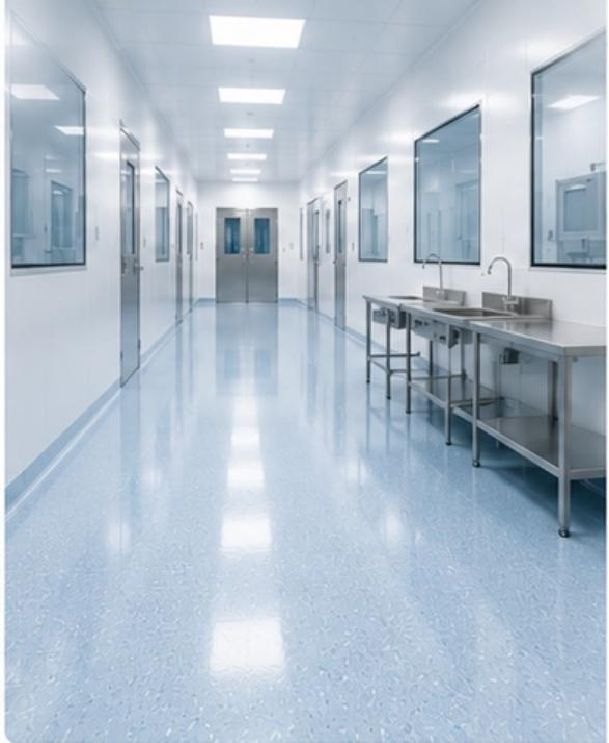
Air has never been just empty space—it is a material waiting to be shaped. By adjusting temperature, humidity, pressure, and flow, designers turn the invisible into an architectural element. Instead of relying solely on walls and roofs, they sculpt thermal layers, direct breezes through narrow gaps, and trap moisture in breathable surfaces. The result is a building that feels alive, responding to each season and even each hour without a single moving part.
Recent work pushes this further by treating air as a structural medium. Pressurized cavities hold up lightweight membranes, while controlled leakage becomes a form of insulation. In some prototypes, zones of differing air density replace solid partitions, creating rooms that can be reconfigured by simply altering ventilation rates. The challenge is no longer whether we can engineer air, but how precisely we can tune its behavior to meet comfort, energy, and spatial needs at once.
What makes this approach compelling is its invisibility. Unlike steel or concrete, air leaves no permanent trace. It can be cleaned, moved, and regenerated with minimal material waste. For architects tired of static forms, engineering the air itself offers a quieter kind of construction—one where the most important walls are made of nothing but difference.
Leaving Zero Room for Contamination
In environments where precision decides outcomes, the quiet enemy isn't always visible. A stray particle, a microbe on a glove, a fingerprint on a vial—these are the details that separate a clean process from a compromised one. The goal isn't just to reduce contamination; it's to eliminate the very possibility of it. That means designing workflows where every surface, every transfer, every transition happens inside a controlled envelope, leaving no gap for the outside world to slip in.
Think of an isolator system in a pharmaceutical fill line. The drug product moves from sterilized vial to sealed container without ever touching open air. Operators interact through glove ports, materials pass through rapid transfer ports, and air itself is filtered to remove anything larger than a virus. There's no “almost clean” stage—it's a binary state: either the barrier holds, or the batch is suspect. This kind of thinking pushes teams to treat every handoff as a potential breach point, and to engineer each one out of existence.
The real shift happens when contamination control stops being a checklist and becomes a design principle. Instead of cleaning up after a spill, you build a path where spills can't happen. Instead of monitoring for particles after they've settled, you create airflow that sweeps them away before they land. When you leave zero room for contamination, you're not just following protocol—you're removing the need for luck.
The Discipline Behind Every Controlled Space
A controlled space is less about the filters and pressure gauges than about the people who enter it. The slow deliberate process of donning gloves, wiping down surfaces in the same pattern every shift, and moving without sudden gestures becomes second nature—but only after months of correction. It is the human routine, not the hardware, that keeps a particle count low.
Small failures rarely announce themselves. A sleeve brushed against a door frame or a vial left open an extra second can undo hours of preparation. This is why the discipline gets baked into muscle memory: hands reach for the right drawer, eyes scan gauges in a fixed order, and every interruption triggers a reset protocol. Consistency becomes the real cleanroom.
What holds the space together is not a list of rules but a shared intolerance for shortcuts. Newcomers learn quickly that the veterans will pause a procedure rather than rush through it. Over time, this strictness turns into pride—a quiet understanding that control is something you maintain, not something you buy.
Where Precision Is a Daily Habit
Precision isn't something we switch on for special projects—it's woven into the way we start each morning, calibrate each instrument, and double-check every measurement before the coffee has cooled. The habit lives in small, almost invisible routines: the way a blade is honed at the same angle every single time, the way a logbook entry never skips a decimal, the way a finished piece is held up to the light and turned slowly before it leaves the bench. This daily repetition strips away the myth that accuracy requires extraordinary effort. Instead, it becomes as natural as breathing.
Over time, the habit shapes more than the work—it shapes the person. A maker who measures twice out of instinct doesn't waste mental energy deciding whether to be careful; the care is already there, layered into muscle memory and expectation. That quiet consistency is what separates a reliable result from a lucky one. And when precision becomes a daily habit, you stop noticing the discipline and start noticing the ease: fewer errors, smoother processes, and a growing trust from anyone who depends on your output.
We protect this habit deliberately, because it's fragile. A skipped step, a rushed glance, a “good enough” muttered under pressure—each one weakens the pattern. So we slow down, not because the task demands it, but because the habit does. The reward is a kind of quiet confidence that doesn't need to announce itself. You can see it in the finished work, in the clean fit of two surfaces that were never meant to meet by accident, and in the calm certainty that tomorrow will be done with the same care as today.
Clean Enough Isn't in Our Vocabulary
For us, cleanliness isn't a sliding scale where you can stop at good enough. It's a line we refuse to cross in the wrong direction. Every surface, every corner, every overlooked spot is treated like it's the first thing someone will notice.
That standard means we don't just wipe down what's visible. We move things, we check underneath, we run our fingers along edges. If a job could be done better, it's not done. There's no box to tick that says acceptable because our measure starts at exceptional.
The result isn't just a spot that looks clean—it's a space that feels different. You might not be able to name it, but you'll notice it when you walk in. That's what happens when clean enough stops being a phrase anyone uses.
FAQ
We don't just install panels and filters—we treat every controlled environment as a living system. Our team combines cleanroom engineering with real-world workflow analysis, so the final space actually reduces contamination risks instead of just meeting a checklist.
A high-class cleanroom is one that balances strict particle control with usability. It's not only about hitting an ISO class on paper; it's about stable pressure cascades, smart material choices, and layouts that let operators work without fighting the environment.
We work mostly with semiconductor, pharmaceutical, and aerospace clients, but we've also built smaller labs for medical device startups and university research teams. The common thread is a need for repeatable, documented control over airborne particles and temperature shifts.
We design around ISO 14644 and, where relevant, GMP guidelines. But rather than stopping at the minimum requirements, we look at the client's specific process—like how often doors open or where gowning happens—and adjust the design to maintain control during real operations.
It starts with a conversation about what the client actually does inside the space, not just the target classification. Then we map particle sources, plan airflow and filtration, and run computational models before any materials are ordered. Clients get a visual walkthrough before construction begins.
We don't disappear after handover. The company provides scheduled performance checks, filter integrity testing, and retraining for operators when procedures drift. If a client's process changes, we help them revalidate the room so it still meets their needs.
Yes, from modular walls and raised floors to specialized pass-through chambers. We avoid forcing a standard template onto every project. Instead, we adapt the shell, HVAC, and monitoring systems around the client's equipment and daily routines.
Conclusion
Walking into a facility operated by a high-class cleanroom company, the first thing that hits you isn't just the absence of dust—it's the quality of the air itself. There's a subtle pressurization you can feel on your skin, a slight hush that tells you the environment has been engineered from the ground up. Every vent, filter, and airflow pattern is tuned so that particles are not merely trapped but actively steered away from critical zones. Laminar flow, differential pressure, and HEPA/ULPA filtration all work in concert, not just to scrub the air but to shape where it goes. It's the kind of place where a cleanroom standard isn't an abstract certificate; it's something you experience the moment the door seals behind you.
Behind that experience sits an obsession with leaving zero room for contamination. Workers follow protocols that have become second nature—no wasted motion, no shortcuts, every tool accounted for. Precision isn't a quarterly goal; it's a daily habit, repeated until it's boring, because boring means stable. In these controlled spaces, the phrase clean enough never comes up. If a particle count creeps anywhere near a threshold, the response is immediate. This discipline, applied without exception, is what separates a company that merely builds cleanrooms from one that sets the benchmark for controlled environments.
Contact Us
Contact Person: Amy Yang
Email: [email protected]
Tel/WhatsApp: 008619330882686
Website: https://www.genopharmatech.com/