

Export Laser Safety Glasses: A Complete Guide for Global Buyers
2026-09-06
Sourcing laser safety glasses for international markets? You already know the stakes are higher than a simple CE mark or FDA registration—wrong optical density, a mismatched wavelength range, or flimsy hinge hardware can put operators at real risk and leave your shipment stuck in customs. This guide walks you through what actually matters when exporting laser protective eyewear: the standards buyers expect, the specs that trip up first-time importers, and how to vet suppliers before you wire a deposit. Along the way, we’ll show you how LASERPAIR handles common export headaches so you can order with confidence instead of crossing your fingers.
Laser Classes and Optical Density: What Actually Matters
Laser classes aren't just legal labels; they tell you how much risk a beam carries under normal conditions. A Class 1 laser is safe during typical use because the beam is fully enclosed or too weak to harm. Class 2 and 2M depend on your blink reflex with visible light, so they're only safe if you don't deliberately stare. Class 3R sits at the edge of low risk, while 3B and 4 can cause immediate eye damage or skin burns. The class shapes the baseline precautions you should take before even touching optical density numbers.
Optical density (OD) quantifies how much a filter or barrier weakens a laser beam — OD 1 means a tenfold reduction, OD 2 a hundredfold, and so on. The number you need depends on the laser's wavelength and the highest possible exposure. However, OD alone can mislead you: filters are wavelength-specific, so a lens rated OD 6 at 1064 nm might be nearly transparent at 532 nm. Always check the attenuation curve for your exact wavelength instead of assuming a single OD value covers everything.
What actually matters in day-to-day use is pairing the right engineering controls with the real beam parameters and setup. A lower class laser with a tightly collimated beam can be more dangerous than a higher class fiber-coupled device with no open emission. Rather than chasing the highest OD rating, pick eyewear or barriers that cover your wavelengths, reduce power below the appropriate exposure limit, and match how the beam is actually used — including reflections off surfaces that many people forget to account for.
Matching Lenses to Wavelengths Without Guesswork
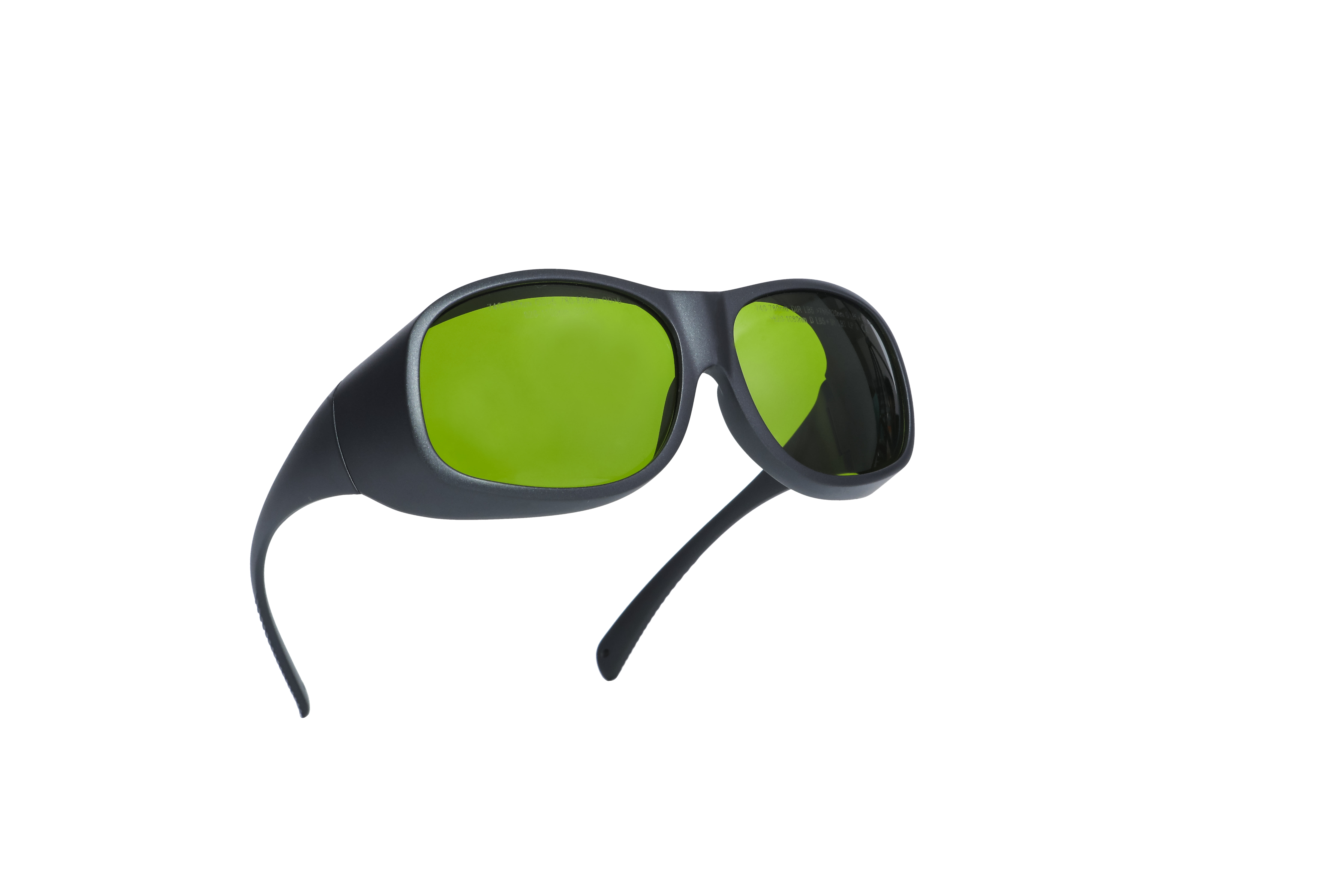
Choosing the right lens for a specific wavelength range used to involve a lot of trial and error. The refractive index of optical glass changes with wavelength, so a lens optimized for visible light will often produce soft focus or chromatic smear in the near-infrared. Instead of relying on generic broadband claims, look for measured dispersion data across the exact band you plan to use. A lens specified with Abbe number and partial dispersion values at your target wavelengths removes most of the uncertainty.
Coatings matter just as much as the substrate. A standard MgF2 coating might perform fine around 550 nm but lose transmission sharply beyond 1000 nm. If you need to work across, say, 900 to 1700 nm, request transmission curves at normal incidence and at the maximum field angle you expect. Pay attention to back reflections too; a coating that suppresses visible ghosting may create a troublesome spike in the short-wave infrared.
Finally, confirm the lens barrel and cement are compatible with the wavelengths. Many UV-grade adhesives fluoresce under blue or UV light, adding stray signal to your measurements. For deep-UV or mid-IR work, ask whether the assembly uses absorptive epoxies or mechanical retention. Once you have that data in hand, matching a lens to a wavelength becomes a straightforward comparison instead of a guess.
CE, ANSI, FDA: A Practical Look at Global Compliance
CE, ANSI, and FDA requirements rarely line up in a tidy checklist. A product that earns a CE mark under the EU’s self-declaration route may still face an entirely different set of hurdles when the same design crosses into the US, where FDA clearance often hinges on clinical or performance data. ANSI standards usually sit in the background as voluntary benchmarks, but they frequently get pulled into contracts, test plans, and FDA-recognized consensus standards, so ignoring them creates friction later.
Teams that treat these as three separate audits tend to stumble. The smarter move is to map the product’s intended use, risk class, and certification path early, then identify overlaps: for example, an ANSI test method might satisfy part of an FDA submission while also supporting the technical file for CE marking. That kind of cross-referencing saves weeks of duplicate work and avoids the trap of designing for one market and retrofitting for another.
At the operational level, documentation habits matter more than certificates. A clean design history file, traceable risk analysis, and consistent labeling rationale make it far easier to answer questions from a notified body, an FDA reviewer, or a test lab citing ANSI. Without those records, even a product that meets every standard on paper can get stuck in review.
Vetting Suppliers Beyond the Spec Sheet
A spec sheet tells you what a supplier claims to build. It rarely hints at how they behave when a batch of raw material arrives out of tolerance, or when a shipment deadline slips by three days. Those unscripted moments reveal far more about reliability than any glossy datasheet. I've learned to ask about the last time a delivery went wrong — and listen for how they describe their own mistake. Defensive answers are a red flag. Honest, detailed ones are rare and valuable.
Walking the factory floor often contradicts the polished documentation. Look beyond the machines themselves: check the maintenance logs, notice whether workers make eye contact or seem rushed, and ask how often they recalibrate their testing equipment. A supplier with spotless paperwork but chaotic inventory rotation will eventually ship you expired components. The physical environment is a living record of priorities.
Vetting properly means having conversations that aren't rehearsed. Instead of asking for their standard quality certificate, ask what they would do if a key subcontractor suddenly raised prices by 30%. Their answer won't appear in any brochure, but it will tell you whether they can protect your supply chain when things get uncomfortable. That kind of insight only comes from pushing past the bullet points and into the awkward, unpolished reality of how they actually operate.
Field Testing Laser Eyewear Before You Commit
When it comes to laser safety, nothing beats putting a pair of frames on your face and seeing how they actually perform. Spec sheets and lab reports only tell part of the story. Before you sign off on a purchase, try wearing the eyewear in the environment where it will be used. Notice the weight distribution, how the temples sit against your head, and whether the lens tint makes it harder to read instruments or spot surface details.
Pay attention to the small annoyances that don't show up in product photos. Does the nosepiece slip after ten minutes of bending over a workbench? Can you still glance sideways without a blind spot from the frame? If you work with multiple laser wavelengths, test each lens option under the actual beams you encounter. A pair that feels fine in an office might become unbearable after an hour on the production floor.
Finally, involve the people who will wear them daily. A quick trial run by two or three technicians often reveals issues that a single evaluator misses. Compare different models side by side rather than testing one at a time. You will spot differences in clarity, comfort, and fit that make the final decision much easier. Field testing turns an abstract safety purchase into a choice you can stand behind.
Avoiding Customs Delays and Hidden Import Costs
Customs delays often start with incomplete paperwork or vague item descriptions. A missing harmonized code, an estimated value that raises eyebrows, or an invoice without a clear country of origin can hold your shipment for days. The fix is surprisingly simple: treat every field on the commercial invoice as if a customs officer will read it line by line. List exactly what is inside, use the correct six-digit HS code, and state the real transaction value in the currency shown on your payment records.
Hidden import costs usually come from fees that are not part of the product price. Beyond the duty rate, you may face brokerage charges, advance payment fees from the carrier, warehouse storage after a free period expires, or a customs bond requirement. Many of these appear only after the goods arrive. Ask your freight forwarder for a full landed-cost breakdown before you ship, and compare it against the terms you agreed with the supplier. If the invoice says DDP, the seller should cover these costs; if it says DAP or FOB, you likely own them from a certain point onward.
A practical habit is to build a small buffer for customs review and payment processing. Ship earlier than your ideal deadline, and keep digital copies of every document linked to the shipment number. When a hold or fee does appear, respond within hours rather than days, because storage and demurrage charges grow daily. Treat customs not as a fixed obstacle but as a process that rewards clear, consistent information and fast follow-up.
FAQ
For the EU, you'll need CE marking under the PPE Regulation (EU) 2016/425, which involves a notified body assessment and EN 207/208 testing. In the US, laser safety glasses must comply with ANSI Z136.1 and be labeled with optical density and wavelength range, though there's no federal pre-market approval; buyers often expect third-party test reports from labs like UL or Intertek. Canada requires CSA Z94.3 compliance. Always check the destination country's specific import rules—some require additional certificates of origin or free sale.
Optical density depends on laser wavelength, power, and exposure duration. You calculate OD = log10(laser power / maximum permissible exposure). But practically, match the glasses' protection range to your laser's wavelength and mode—continuous or pulsed. For example, a 1064 nm Nd:YAG laser at 10 watts typically needs OD 5 or higher. Avoid guessing: request a spectral transmission curve from the manufacturer and verify it covers your exact wavelength band.
Many buyers overlook the difference between EN 207 and EN 208—EN 207 covers full protection against direct beam, while EN 208 is only for alignment tasks at lower power. Another mistake is accepting CE certificates for the frame but not the lens, or assuming ANSI and EN ratings are interchangeable. Also, failing to confirm the optical density at a specific wavelength (e.g., 532 nm vs 1064 nm) leads to unsafe gear. Ask for batch test reports and request samples for independent lab testing before bulk orders.
EN 207 (European) tests the entire assembly—frame and lens—against direct laser exposure at defined power densities, and assigns a protection level (e.g., D LB6). ANSI Z136.1 (US) focuses on optical density at specific wavelengths and relies on labeling; it doesn't require the same frame resistance testing. So a pair marked OD 5 under ANSI might not survive direct beam contact under EN 207. For global buyers, if you export to Europe, EN 207 is mandatory; for the US, ANSI-labeled glasses are standard but many companies use EN 207 as an extra safety margin.
Typically, include a commercial invoice, packing list, bill of lading, certificate of origin, and the product's CE marking documents if going to the EU. You'll also want test reports (EN 207/208 or ANSI Z136.1 compliance) and a safety data sheet for the frame material. Some countries require an import permit for laser products, so verify with the destination customs broker. Keep the HS code for laser safety glasses handy—often 9004.90.00 or similar, but confirm with local tariff schedules.
Start by requesting a pre-production sample and have it tested by an independent lab for optical density and visible light transmission. Ask the supplier for the CE Type Examination certificate and the name of the notified body—then cross-check that body's certification database. If possible, audit the factory's quality control process, especially lens coating consistency and frame durability tests. Don't rely solely on the supplier's in-house test reports; a small batch test can reveal variances in OD across different wavelength ranges.
In the EU, each pair must carry a CE mark, the manufacturer's name, the standard (EN 207/208), and protection level like D LB5 plus wavelength range. In the US, ANSI Z136.1 requires marking the optical density and wavelength, plus a warning label about laser hazards. Some markets also require the not-for-direct-beam-viewing warning if the glasses are only for diffuse reflections. Traceability markings—batch number and production date—are becoming standard for recalls and quality audits. Make sure the marking is permanent, not a sticker that can peel off.
Conclusion
When sourcing laser safety glasses for export, buyers often chase impressive spec sheets without realizing that the core decisions come down to two numbers: the laser's class and the required optical density. A Class 4 laser demands far higher attenuation than a Class 3R alignment tool, and misunderstanding this gap can lead to eyewear that is either dangerously under-specified or unnecessarily dark. Instead of guessing, match the lens's protective wavelength range to the exact nanometers your equipment emits—whether that's 1064 nm for Nd:YAG or 532 nm for frequency-doubled systems. On the compliance side, no single mark covers every destination market. CE certification follows EN 207/208, which tests frames and filters as a system under direct hit conditions, while ANSI Z136 in the U.S. and FDA registration focus on different performance and labeling requirements. Savvy buyers confirm which standard the end user's local safety authority actually enforces, rather than assuming a CE mark works everywhere.
Beyond the printed data, real protection depends on how the glasses perform in the field and how they survive the import process. Ask suppliers for batch test reports and, if possible, run a low-power trial with your own laser before committing to a container order. Check for edge leakage, comfort over long shifts, and whether the frame fits over prescription lenses. Customs delays are often caused by incomplete documentation, especially the correct HS code and a clear statement of optical density on the commercial invoice. Some countries also apply additional duties to protective equipment, so factor those into your landed cost before quoting to your own customers. A supplier that proactively offers user manuals and local-language labeling will save you weeks at the border and reduce the risk of rejected shipments. In short, treat laser eyewear as a safety-critical product, not a commodity—your reputation and your buyers' eyesight depend on it.
Contact Us
Contact Person: Jenny
Email: [email protected]
Tel/WhatsApp: +86 13537713281
Website: https://www.laserpair-safety.com/