

Best Cabinet-Type Static Var Generator Manufacturer for Reliable Power Quality Solutions
2026-09-07
In the realm of modern power systems, voltage fluctuations and reactive power issues can silently undermine equipment performance and escalate operational costs. When reliability is non-negotiable, choosing the right static var generator becomes a strategic decision—not just a technical one. Among the global players, GEYA stands out as a manufacturer that pairs cabinet-type design with uncompromising power quality engineering. But what makes a cabinet-type SVG truly dependable? And why do engineers increasingly turn to one name when uptime is everything? This article explores the hallmarks of a best-in-class cabinet-type static var generator and reveals how the right choice can transform your power infrastructure from a hidden liability into a competitive advantage.
Why Cabinet-Type SVG Units Fit Better in Crowded Electrical Rooms
Standard SVG systems often come as open-frame assemblies that demand generous clearances on all sides for airflow and service access. In a crowded electrical room, that wasted perimeter space adds up quickly. Cabinet-type units pack the same power electronics into a standard switchgear enclosure, typically 600mm or 800mm wide, so they can slide into existing rows or sit flush against a wall without leaving dead zones.
The real advantage shows up during installation and routine maintenance. Because the cabinet integrates busbars, cooling fans, and control modules behind a single front door, technicians never need side or rear access. You can place two units back-to-back or tight against a corner, and still swap a failed power module without pulling the whole system out of line. That flexibility is hard to achieve with open-frame designs, which usually require a meter or more of clearance behind the unit for cable routing alone.
Cable management also gets cleaner. All power and signal connections terminate inside the cabinet through gland plates or bottom entry points, so there are no exposed busbars or dangling control wires to snag on nearby equipment. In tight rooms where every square meter is contested, that tidy footprint means fewer accidental contact risks and a faster, safer retrofit into an existing lineup.
The Testing Sequence That Catches Reactive Power Drift Before Shipping
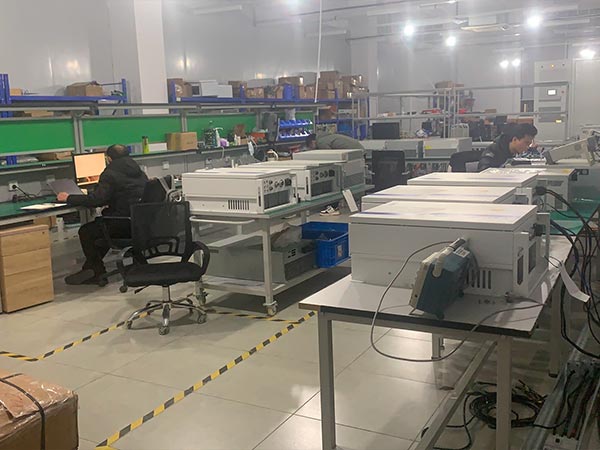
Every unit gets pushed through a sequence that starts with a low-load idle check, then steps up in 15% increments to full rated output. At each step, the test bench logs reactive power against the expected curve rather than just the final value. A slow upward lean in the middle of the range often shows up three or four steps before the spec limit is crossed, so the operator can flag the board while it is still on the fixture.
The real catch comes from comparing the drift pattern to the last five production batches. A healthy unit might wander a few VARs under thermal load, but the slope stays flat after the first ten minutes. If the reactive power keeps creeping while temperature holds steady, that points to a marginal compensation network or a drifting sense resistor. The sequence runs long enough to separate those thermal artifacts from genuine instability.
Only after the unit holds its reactive power within a narrow band through two full load cycles does it move to packaging. It is not a pass/fail snapshot; it is a short stress profile that happens to expose the kind of failure that would otherwise surface in the field a week later. That final gate costs a little bench time, but it keeps the return rate flat and the ship line clear.
Matching Static Var Generator Response Time to Your Load Changes
A reactive power compensator that lags behind your equipment's actual demand creates more problems than it solves. If your process starts and stops motors, welders, or crushers in rapid succession, the Static Var Generator must track those swings almost instantly. Otherwise, you will see voltage dips, flicker, and unnecessary penalties from the utility. The goal is not just fast response in a lab test, but a response curve that stays locked to the real-world pattern of your load.
Look at the time constants in your facility before selecting a unit. Some loads change within a single cycle, while others drift over several seconds. A Static Var Generator with a sub-cycle response may be overkill for slow-moving thermal processes, but it becomes essential for arc furnaces or automotive stamping lines. Ask the manufacturer for detailed step-response data under partial load, not just the headline number at full output. The inverter's control loop, sampling rate, and output filter all shape how quickly it can correct a sudden imbalance.
Matching response time also affects component stress and audible noise. A unit that reacts faster than needed often switches more frequently, generating extra heat and shortening capacitor life. On the other hand, a sluggish response forces your upstream transformer and cables to absorb the reactive swings. Run a short trial with your actual load profile, and compare voltage stability and power factor correction against your baseline. The right match is the one that disappears into your electrical system, correcting what needs correcting without drawing attention to itself.
Thermal Design Choices That Extend Cabinet Life in High-Harmonic Environments
High-harmonic environments impose atypical thermal stress on electrical cabinets, largely because non-sinusoidal currents elevate both core and winding losses in magnetic components and create localized eddy-current heating in busbars and connectors. What often gets overlooked is that the resulting heat is neither uniform nor predictable using standard load calculations. A cabinet that passes a conventional thermal audit under linear loading can develop persistent hot spots when harmonic content rises above 15–20% THD. These hot spots accelerate insulation aging, dry out electrolytic capacitors, and cause intermittent tripping of thermal protection devices. The first design choice that actually extends cabinet life in such settings is to stop treating heat as a bulk average and instead map it at the component level under representative harmonic spectra.
Practical thermal design choices then diverge from generic practice. Airflow paths need to be rerouted so that harmonic-sensitive components—IGBT modules, filter reactors, power factor correction capacitors—sit in cool inlet streams rather than in recirculation zones. Using thermally conductive but electrically insulating potting compounds or ceramic-filled gap pads helps pull heat out of tightly packed harmonic filter stages. In many retrofit cases, adding small dedicated heat sinks to neutral conductors and harmonic trap inductors yields a disproportionate gain because these parts are often the first to fail from thermal fatigue. For cabinets that cannot accommodate larger fans, replacing solid steel side panels with baffled, RFI-shielded vent panels lowers internal ambient temperature without compromising electromagnetic compatibility. These choices are not about maximizing airflow but about directing it where thermal gradients are steepest.
The cumulative effect of these targeted measures is a measurable extension of cabinet service life, often beyond what nameplate derating would suggest. By shaving ten to fifteen degrees Celsius off the hottest internal nodes, the Arrhenius-driven aging of insulation and semiconductor junctions slows considerably. Equally important, reducing thermal cycling amplitude minimizes solder joint cracking and connector fretting that plague equipment operating near harmonic-rich drives or arc furnaces. A less obvious benefit is that well-executed thermal design lowers the need for aggressive fan speeds, which in turn reduces dust ingress and bearing wear. In high-harmonic environments, the cabinets that last are rarely the ones with the most powerful cooling; they are the ones where heat is managed as a dynamic, uneven load rather than a static design parameter.
How to Avoid Overcompensation When Sizing a Power Quality Cabinet
Overcompensation often starts with stacking conservative assumptions. If every harmonic filter is rated for maximum nonlinear load running simultaneously at peak distortion, the cabinet ends up oversized, costly, and sometimes less effective at partial load. Instead, gather real operating data from the existing installation or a similar process. Look at measured THD, load diversity, and typical duty cycles rather than nameplate ratings alone. That baseline tells you where actual problems sit and how much correction is genuinely needed.
A second common trap is adding a blanket future-growth margin on top of already padded calculations. It is usually simpler to leave physical space and spare breaker slots for later expansion than to install capacitors, reactors, or active filters far beyond current demand. Size for the load profile you can defend with data, then document the spare capacity as a layout decision, not as extra kvar or amps purchased upfront.
Finally, avoid treating power factor correction and harmonic filtering as separate worst-case requirements that simply add together. Their interaction changes the effective impedance and resonance points, so a combined study prevents double counting. If you cannot monitor the site beforehand, use interval data from similar operations and apply a coincidence factor that reflects how often heavy nonlinear loads actually overlap. That keeps the cabinet compact enough to fit the available space while still leaving headroom where it matters.
Questions to Ask a Manufacturer About Service and Spare Parts Availability
Before you sign anything, pin down how a manufacturer handles the moments after the sale. Ask for the typical response window for service calls and whether they have local technicians or rely on third-party contractors. If a critical part fails, how long will it actually take to arrive at your facility? A vague “we ship fast” is not enough—request realistic lead times for common wear items and ask if they stock spare parts regionally or only at the main factory.
Also probe their long-term support philosophy. What happens if this model gets discontinued next year? Will spare parts remain available for five, ten, or fifteen years? Get the name of a real person responsible for service decisions, not just a generic support inbox. Ask existing customers about their experience with downtime, and whether the manufacturer proactively suggests maintenance parts before failures occur. The goal is to uncover whether the company sees service as a profit center or as a partnership that keeps your operation running.
FAQ
A cabinet-type SVG responds in milliseconds and can adjust reactive power continuously, so it avoids the stepped switching and potential resonance issues you often see with capacitor banks. That means fewer voltage swings and a more stable supply for sensitive equipment.
Look for symptoms like frequent voltage dips, penalties on your utility bill for poor power factor, overheating transformers, or nuisance tripping of drives and PLCs. If these issues persist even after basic power factor correction, a cabinet-type SVG is worth evaluating.
Look beyond the datasheet. Ask about their track record with similar loads, whether they can provide reference installations, how they handle harmonic-heavy environments, and what kind of support they offer after commissioning. A manufacturer that asks detailed questions about your load profile is usually a good sign.
Yes. A well-designed unit operates in all four quadrants, so it can supply reactive power to inductive loads and absorb it from capacitive loads. This flexibility is especially useful in facilities with a mix of motors, drives, and long cable runs.
Most units are designed for low maintenance, but you should still keep air filters clean, check cooling fans, and inspect connections annually. In dusty or high-temperature environments, more frequent checks help maintain reliability and extend the life of the power modules.
Faster response means the unit corrects reactive power changes before they cause voltage sags or flicker. For equipment like CNC machines or medical imaging systems, that can be the difference between smooth operation and unexpected downtime.
Many manufacturers offer NEMA 3R or IP54 rated enclosures for outdoor use, but you need to confirm cooling capacity and ambient temperature limits. If your site has extreme dust, humidity, or temperature swings, an optional air-conditioned enclosure may be a better choice.
In most modular designs, yes. You can often add power modules or parallel additional cabinets, as long as the control system supports it. It is wise to plan for expansion at the initial purchase so the manufacturer can reserve space and communication interfaces.
Conclusion
Cramped electrical rooms punish equipment that demands generous clearance, which is why the best cabinet-type static var generator manufacturer focuses on front-access, wall-hugging designs. Cabinet-type SVG units earn their place by consolidating power stages, control boards, and cooling into a single enclosure with no rear access requirement. Before any unit leaves the factory, it runs through a staged bench protocol that checks no-load voltage, stepped inductive and capacitive injections, and repeated thermal cycles while monitoring reactive current drift. This sequence weeds out minor parameter shifts that would otherwise surface only after installation. Field performance depends on response speed matching actual load behavior. A rolling mill or welding line needs sub-15 ms correction; a water treatment plant with slower pump starts can accept 30–50 ms without voltage flicker. Asking for a fixed response time without a load profile invites either unnecessary hardware cost or sluggish correction.
High-harmonic environments shorten component life unless thermal design treats heat as a constant enemy. Look for oversized heatsinks, ducted airflow that isolates power electronics from control circuits, and derated capacitors rated for continuous 50°C ambient. Sizing matters just as much. Oversizing a cabinet to "be safe" often creates leading power factor and resonance risk, so a proper study of minimum, typical, and peak reactive demand prevents overcompensation. Finally, a reliable manufacturer should answer plainly how long they stock spare control boards, whether firmware updates are field-installable, and what regional service response looks like five or ten years out. The best supplier treats those questions as routine, not as negotiation friction.
Contact Us
Contact Person: Leo
Email: [email protected]
Tel/WhatsApp: +86-13567770207
Website: https://www.geyapower.com/