

Automatic Die Making Steel Rule Die Bender Machine Manufacturer Tips for Higher Productivity
2026-09-08
Every bent steel rule that doesn't fit the first time costs you time, material, and patience. In this post, the team behind ADEWO automatic die making machines breaks down practical tips to increase your bending productivity—drawn from real production environments, not just theory.
Fine-Tune Bend Radius Settings for Cleaner Cuts
Default bend radius settings rarely match the actual behavior of your cutting tool. If the radius is too tight, the head has to brake hard into a corner, which can leave a rounded inside edge or a small tear on softer stock. Loosen it too much and you waste time on wide, lazy arcs that miss the crisp geometry you need.
The quickest way to dial this in is to run a corner test on scrap. Cut a square with 90-degree corners and inspect the exit side. A clean corner will have no burn mark, no lifted fibers, and no blade drag. If you see any of those, increase the bend radius by a few hundredths of a millimeter and test again. You'll often find the sweet spot sits well below the software default.
Remember that material stiffness changes the ideal value. Thin vinyl can handle a very tight radius, while thick chipboard or acrylic needs a wider turn to avoid cracking or chipping. Keep a note card with proven radius values for each stock you run, and update it whenever you change blade depth or cut speed.
Pair Steel Rule Profiles with Die Clearance Specs
When cutting rigid paperboard, a center bevel rule typically performs best with a single-side clearance of 8-10% of material thickness, while a side bevel profile demands roughly 12-14% because the offset cutting edge shifts the material more before separation. Treating all profiles with the same clearance wears dies faster and leaves fuzzy edges on the underside of the sheet.
Material resilience changes this baseline substantially. High-density polyethylene, for instance, needs a tighter clearance than polyurethane foam of the same thickness—too wide a gap on HDPE creates a rolled-over top edge, while too tight on soft foam tears the cell walls. Start at 8% of stock thickness for dense plastics, then adjust in 0.01 mm steps after a short test cut, watching for burr formation on the bottom face.
Regrinding a steel rule alters its bevel angle and can invalidate the original die clearance. After any sharpening cycle, re-measure the actual cutting width at the rule's shoulder and set the die clearance with a feeler gauge rather than reusing the old shim stack. A five-minute verification prevents the slow drift toward ragged cuts that often gets blamed on material lot variation.
Automate Repetitive Bends Using Stored Job Recipes
Every shop has that one part that keeps coming back, and re-entering the same bend angles, tooling setups, and backgauge positions each time wastes hours. Stored job recipes change that. Once a job runs successfully, the entire sequence can be saved under a clear name or number. The next time the part appears on the schedule, an operator simply recalls the recipe instead of rebuilding the program from scratch.
This approach does more than save time. It protects consistency across shifts and machines, because every operator loads the exact same validated data. Small tweaks for material variation can be made on the fly and saved as a new revision. Over time, a library of proven recipes becomes one of the shop's most useful assets, making repeat work feel less like starting over and more like picking up where you left off.
Lubricate Guide Rails to Reduce Friction and Wear
Regular lubrication of guide rails is essential for maintaining smooth motion and extending the lifespan of machinery. Without proper lubrication, metal-to-metal contact leads to increased friction, which not only causes excessive wear but also generates heat that can degrade both the rail and the moving components. A thin, consistent film of lubricant acts as a protective barrier, reducing direct contact and preventing micro-welding between surfaces. This simple maintenance step can dramatically lower the risk of premature failure and keep equipment running quietly and efficiently.
Choosing the right lubricant is just as important as the act of lubricating itself. For most linear guide systems, a light machine oil or a specialized rail grease works well, depending on the load, speed, and operating environment. In dusty or dirty conditions, a dry lubricant such as PTFE spray may be preferable because it does not attract contaminants like wet oils do. However, in high-load industrial settings, a heavy-duty grease with extreme pressure additives provides better cushioning and stays in place longer. Always clean the rail surface before applying fresh lubricant to avoid trapping abrasive particles that can accelerate wear.
Establishing a regular lubrication schedule based on actual usage rather than guesswork will yield the best results. Machines that run continuously need more frequent attention than those used intermittently, and rails operating in high-temperature or washdown environments may require special formulations. A simple visual inspection can help determine if relubrication is needed: if the rail appears dry, shiny in patches, or if movement feels rough, it is time to reapply. By making guide rail lubrication a routine part of maintenance, operators can prevent costly downtime and keep precision equipment performing at its peak.
Inspect Rule Alignment After Material Changes
Swapping a specified alloy for a cheaper alternative often triggers a cascade of rule mismatches that go unnoticed until a downstream process fails. The first check should always be against the original material callout on the drawing or model, not just the physical properties listed in the bill of materials. Compare density, thermal expansion, and surface finish requirements against the current design rules for clearance, interference, and post-machining tolerances. If the new material has a different springback or work-hardening rate, bend allowances and flat pattern calculations need to be recalculated before releasing the change to production.
Rule alignment also extends to coating adhesion, weld procedures, and corrosion allowances. A material substitution that passes tensile strength requirements may still violate rules around galvanic compatibility or minimum edge distance for fasteners. Pull the revision history of the original material approval and note any special dispositions or waivers that were tied to the previous grade. Those waivers rarely transfer automatically, and assuming they do can lead to rejected first articles or field failures. Keeping a side-by-side matrix of the old and new material data against each active design rule is the fastest way to catch misalignment before tooling is cut.
Finally, run a dry simulation or sample batch through the same inspection gates used for first article approval. Check hardness after heat treat in the exact zones where the old material met the upper or lower spec limit. If the new stock is more prone to variation, tighten the incoming material certification checks and add a note to the control plan. This isn't about proving the substitute is identical; it's about confirming that every rule originally written for the baseline still holds true when the material reality shifts.
Track Production Metrics to Spot Bottlenecks Early
Metrics are the raw material of manufacturing insight, but only when you pull them before the line stalls. A scanner log that shows three extra seconds per cycle on station four might not trigger a red flag on its own—yet across four hundred units, that quiet drift becomes forty minutes of lost throughput. The trick is to watch movement, not just averages: a sudden widening in the gap between planned and actual takt time often shows a bottleneck forming hours before a jam stops work entirely.
What you track matters less than how you slice it. Throughput per operator, reject reasons by shift, or the number of times a feeder pauses for refill—all are useful, but only if they point to a specific constraint. Instead of chasing every dip in OEE, pick the two or three numbers that, when they move, force a decision. If your rework rate climbs on Tuesday afternoons but not Mondays, you don't have a quality problem; you have a staff handoff problem pretending to be a quality problem.
Finally, make the metric visible where the work happens, not just in a Friday report. A simple board updated every hour with current cycle time versus target does more to prevent a bottleneck than a sophisticated dashboard nobody opens. The goal is early detection, not post-mortem analysis—so watch the numbers that change hour by hour, and train yourself to hear the difference between normal variation and the first rumble of a constraint about to bite.
FAQ
Check the rule material first. Inconsistent hardness or thickness across batches will show up as angle drift even when the machine settings never change. Measure a few samples at the start of every shift, and if you see more than a couple of tenths of a millimeter variation, reject the stock. After that, look at the bending head pressure and the die clearance. Too much clearance lets the rule shift slightly during the bend, which ruins repeatability. Lubricating the slide rails and keeping the bending area free of metal dust also makes a bigger difference than most people expect.
Focus on the small moving parts that get ignored. Clean the linear guides and ball screws every day, not just when they look dirty. Check the proximity sensors and micro switches for buildup from steel dust or adhesive residue. Grease the tooling clamp and the bending mandrel pivots on the schedule in the manual, but use the exact grease type specified. Also watch the wiring harnesses near the bending head. Vibration loosens connectors over time, and a loose sensor wire will stop a full production run.
Yes, but only if you actually save and reuse the parameter sets. Most automatic benders can handle a decent range of rule heights and thicknesses, but the bend angle compensation changes with material thickness. Set up a test bend for each rule type, measure the springback, and store those offset values under a named recipe. If you just change the height and keep the old angle settings, you will get over-bent or under-bent rules. Using quick-change tooling inserts for different rule widths also avoids re-zeroing the machine between jobs.
A common one is teaching operators to trust the displayed bend angle without verifying the actual part. Screens can be misleading if the calibration has drifted. Another mistake is letting one person hoard the recipe libraries without documenting them. If only one operator knows the correct settings for a difficult layout, output drops the moment that person is away. Also, many operators ignore small feed errors at the start of a run. A rule that slips by half a millimeter on the first bend will force rework later, so training should emphasize stopping and checking instead of letting the machine run blind.
It changes everything about the process. Steel rule with a hard, brittle edge can crack at tight bend radii, while soft rule may bend too easily and then relax unevenly. The surface finish matters too; oily or contaminated rule can slip in the feed rollers, causing length variations. Even the way the rule is wound on the spool affects speed. If the coil has a strong set or uneven tension, the bender has to fight the material. Buying from a supplier that guarantees tight thickness tolerance and clean, dry strip will reduce setup time and scrap more than any software tweak.
In many cases, yes. Newer software often reduces unnecessary travel moves, which cuts cycle time without pushing the mechanical parts harder. You also get better import filters for CAD files, so less time is spent manually entering bend sequences. If you run a mix of simple and complex layouts, look for software that can optimize bend order automatically and warn about impossible geometries before you waste rule. Just make sure the upgrade supports your existing controller and that the vendor provides a migration path for your current recipe library.
Acceleration and deceleration values get ignored constantly. If the machine ramps up too slowly on short moves, you lose a second or two on every bend, which adds up over thousands of bends. Another overlooked setting is the dwell time after bending. Too long a dwell slows the cycle, but too short can release the rule before springback settles. Also check the feed roller pressure. Excessive pressure can mar the rule and increase drag, while too little pressure causes slippage. Spend an afternoon tuning these three areas and you will often see a bigger gain than buying a new machine.
Standardize the job preparation instead of treating each layout as a one-off. Keep a physical sample of every rule profile you commonly bend, along with a printed setup sheet that lists feed length, bend angle offset, and tooling insert numbers. Use quick-release clamps and pre-set tooling blocks so changing over takes minutes, not an hour. If your software allows offline programming, prepare the bend sequence on a PC while the machine is still running the previous job. Then when the new job loads, the operator only has to verify the first piece and adjust minor offsets.
Conclusion
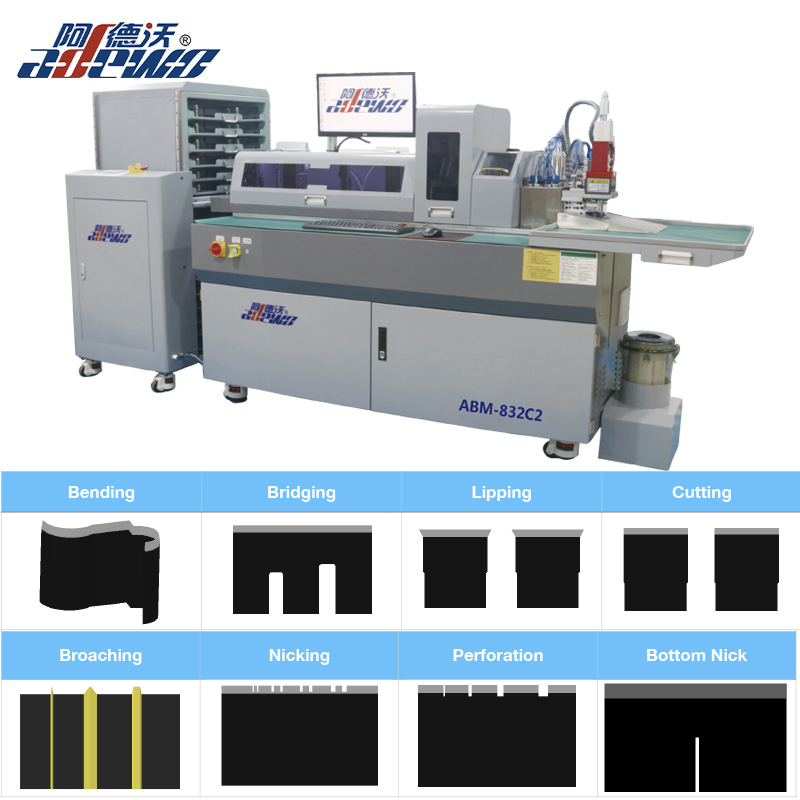
Getting more out of an automatic steel rule die bender often comes down to small adjustments that compound over a shift. One overlooked area is bend radius calibration. When the radius is dialed in properly for the rule profile, you get sharper, cleaner cuts downstream and fewer burrs that force rework. Pairing the steel rule profile with the correct die clearance specs prevents excessive wear on both tooling and machine, so a quick reference chart at the station can save hours of trial and error. For shops running repeat jobs, stored job recipes turn repetitive bending into a one-touch task. Instead of re-entering angles and depths each time, operators can load a proven setup and keep the machine producing consistent parts. Regular lubrication of guide rails is another low-cost habit that pays off in smoother travel and fewer friction-related breakdowns.
After any material change, take a few minutes to inspect rule alignment before running production. A new coil of steel or a different hardness can shift how the rule sits in the channel, and catching misalignment early avoids scrap and damaged tooling. Beyond the machine itself, tracking production metrics such as bends per hour, downtime causes, and average setup time gives you a clearer view of where bottlenecks form. Instead of guessing why output dipped, you can see which job or material caused the slowdown and address it directly. These practices don't require a major overhaul—just consistent attention to settings, maintenance, and data. Over time, they add up to noticeably higher productivity from the same automatic die making steel rule die bender.
Contact Us
Contact Person: KAELYN LEE
Email: [email protected]
Tel/WhatsApp: +86 15012673758
Website: https://www.china-adewo.com